

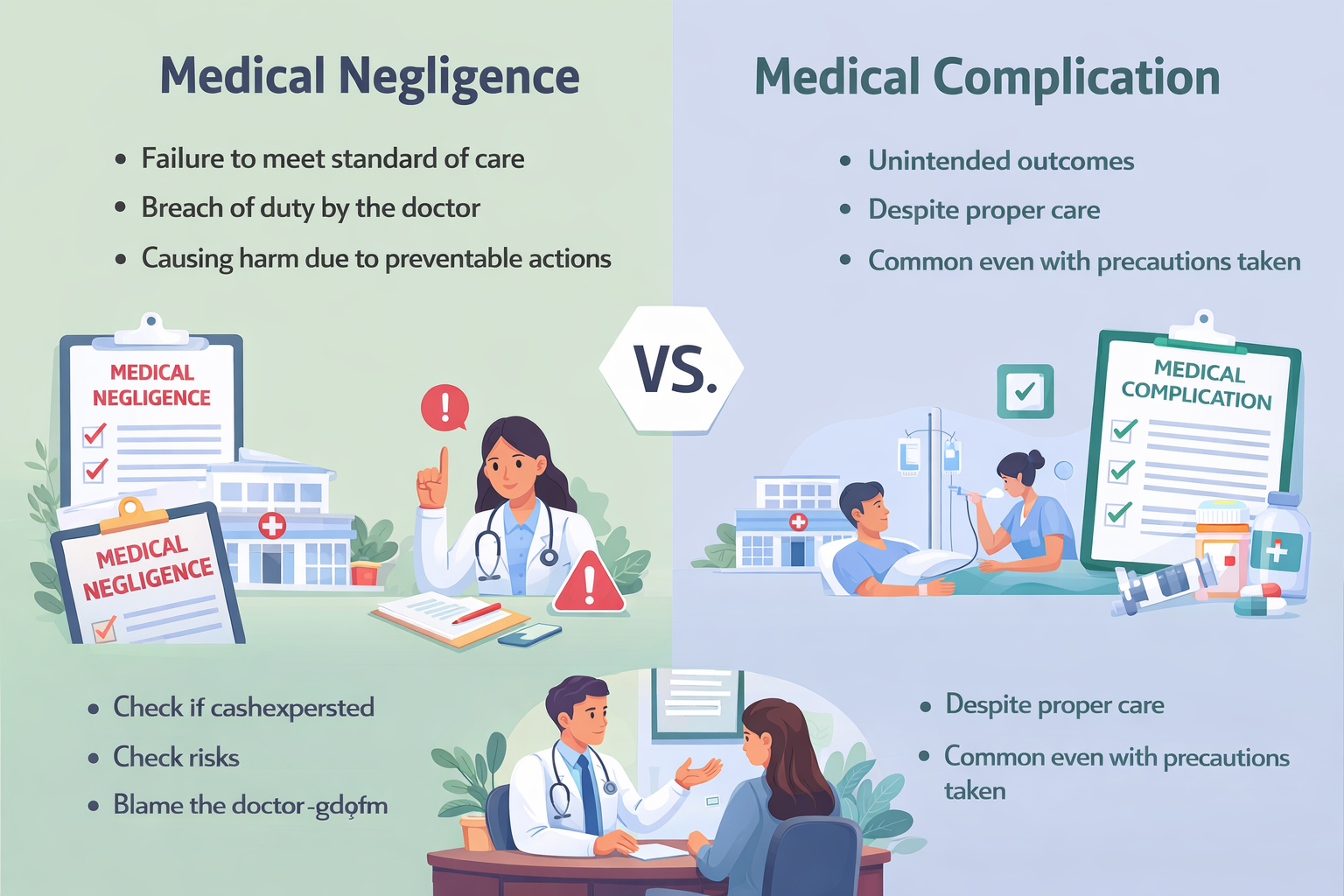
Medical Negligence vs. Medical Complications: Understanding the Legal Difference
By Adv. Arun D. Mishra — Medico-Legal Consultant & Advocate
One of the most common misconceptions I encounter in medico-legal cases is the belief that “If something went wrong, the doctor must be negligent.”
This misunderstanding is responsible for a large percentage of unnecessary complaints and litigation.
Let me clarify this with a case I handled a few years ago.
A patient underwent a laparoscopic appendectomy at a reputed hospital and later developed an infection. The family immediately assumed negligence and filed a police complaint. However, when we presented international medical literature and the Medical Board examined the file, they confirmed that post-operative infections occur even in the world’s top hospitals, despite flawless surgical technique.
The surgeon had followed standard protocol, monitored the patient properly, and documented everything.
The case was dismissed.
This example shows the fundamental difference between a complication and negligence.
What Is a Medical Complication?
A complication is an unintended outcome that happens despite appropriate care. It is part of medical science, not medical error.
Examples:
- Bleeding after surgery
- Drug reactions
- Post-operative infections
- Allergic responses
- Anesthetic complications
Complications occur even when the doctor does everything correctly.
What Is Medical Negligence?
Negligence is a breach of the standard of care. It happens when:
- A doctor had a duty of care
- That duty was breached
- The breach directly caused harm
Unless all three conditions are proved, negligence cannot be established.
Courts rely heavily on expert opinions, documentation, and clinical guidelines to differentiate one from the other.
How Do Courts View This Difference?
One of the most important judgments in India, Jacob Mathew v. State of Punjab, clarified that doctors cannot be held criminally liable for ordinary complications.
The court said:
“Failure of treatment is not proof of negligence.”
This principle continues to guide medico-legal decisions across India.
Why Doctors Must Understand This
When doctors understand the legal definition, they are able to:
- Document better
- Communicate clearly
- Handle complications confidently
- Protect themselves from false allegations
A complication is not your fault.
Negligence is a legal violation and the two must never be confused.